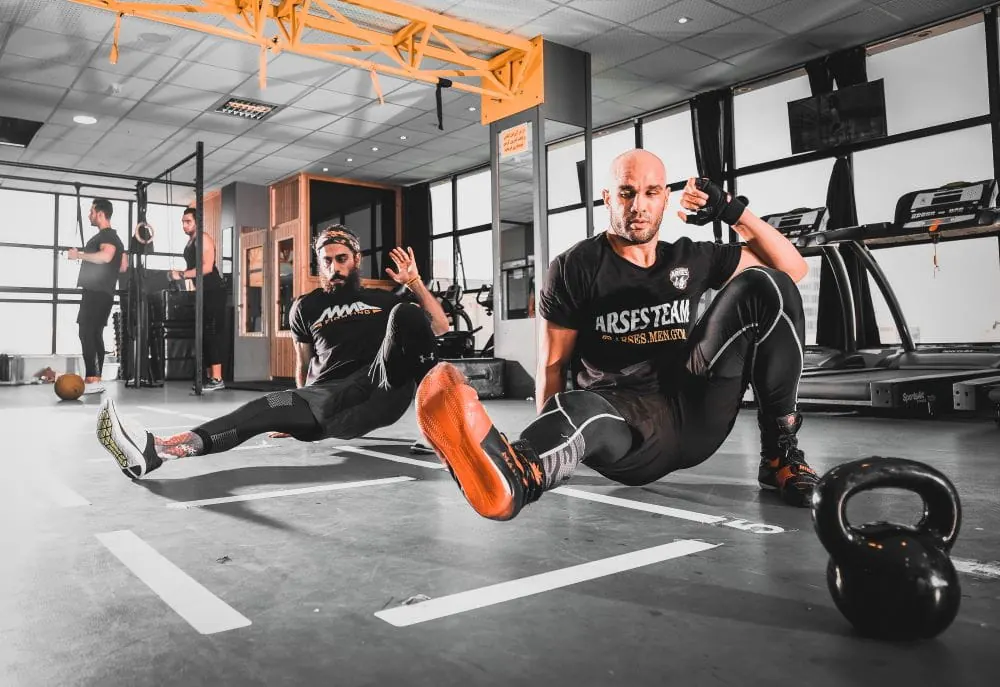
It is one of the most common questions from people setting up a home gym: should you buy resistance bands or free weights? Both can build real strength and muscle, but they load your body in different ways, cost different amounts, and suit different spaces and goals. This guide to resistance bands vs free weights breaks down how each works, what each is best at, and how to combine them for the most results per dollar.
How Bands and Free Weights Create Resistance
Free weights: constant load
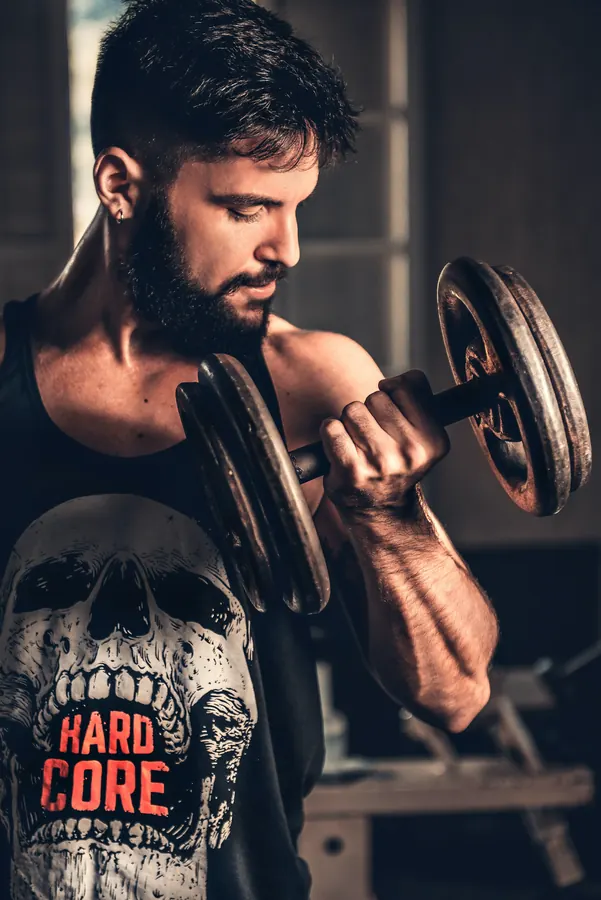
A 30 lb (13.6 kg) dumbbell weighs 30 lb at every point of a movement, and gravity always pulls it straight down. That means the difficulty of an exercise changes with your body's leverage. In a dumbbell curl, the hardest point is when your forearm is parallel to the floor, because that is where the weight is farthest from your elbow. At the top, the load almost disappears.
Resistance bands: variable load
A band follows a simple rule: the more you stretch it, the more it pulls back. Tension is lowest at the start of a rep and highest at the end. A band that gives around 10 lb (4.5 kg) of tension at the bottom of a squat might give 30 lb (13.6 kg) or more at the top. Bands also pull in the direction they are anchored, not just downward, so you can load horizontal movements such as presses, rows, and rotations that are awkward with weights.
Why the strength curve matters
Every exercise has a strength curve, the pattern of where you are weak and where you are strong through the range of motion. In squats, presses, and hip thrusts you are usually strongest near lockout. Bands match these "ascending" curves well, adding tension where you can handle it. Free weights challenge the bottom and middle of the range, where muscles are stretched and often where strength is built most effectively. Neither is better in every case; they emphasize different parts of the movement.
Muscle Growth and Strength: What Actually Matters
The general consensus in exercise science is that muscles respond to mechanical tension and effort, not to the specific tool. If you take sets close to failure, around RPE 7–9 or 1–3 reps short of failure, and gradually increase the challenge over weeks and months, you can build muscle with bands, dumbbells, barbells, or machines.
Where the tools differ is in how easy it is to keep progressing:
- Progression is clearer with free weights. Going from 40 lb to 45 lb (18 to 20 kg) is a precise, measurable step. With bands, tension changes depend on stretch, stance, and anchor point, so progress is harder to track.
- Heavy lower-body loading favors weights. Strong legs and hips quickly outgrow even heavy bands for squats and hinges, especially for sets in the 5–10 rep range.
- Bands are excellent for upper-body accessories. Rows, face pulls, lateral raises, triceps pressdowns, and curls all respond well, and you can push close to failure with little joint stress.
- Maximal strength needs heavy, specific practice. If your goal is a bigger squat, bench, or deadlift, you will need free weights, ideally a barbell.
Beginners can make excellent progress with bands alone for several months. Our beginner full-body home workout plan starts with bands and bodyweight before adding dumbbells for exactly this reason.
Cost, Space, and Portability Compared
For many home trainers, the practical factors decide the question. Here is how the main options stack up, using typical new US prices.
| Factor | Resistance bands | Adjustable dumbbells | Fixed dumbbells | Kettlebells |
|---|---|---|---|---|
| Typical cost | $25–$60 for a full set | $200–$450 per pair | $500–$1,200+ for 5–50 lb (2–23 kg) pairs | $40–$120 each |
| Floor space | A drawer or hook | About 2 x 3 ft (0.6 x 0.9 m) with stand | A 4–5 ft (1.2–1.5 m) rack | A small corner |
| Portability | Excellent, fits in a backpack | Poor, heavy | Very poor | Poor |
| Load range | About 5–150 lb (2–68 kg) of tension, varies with stretch | About 5–90 lb (2–41 kg) per hand depending on model | Unlimited with more pairs | One load per bell |
| Tracking progress | Approximate | Precise | Precise | Precise but large jumps |
| Noise and floor risk | Very low | Moderate | Moderate to high | Moderate to high |
| Lifespan | 1–3 years with regular use | Many years with care | Decades | Decades |
If you are working with a tight budget, see our guide to building a home gym on a budget for full shopping lists at $300, $1,000, and $2,500.
Types of Resistance Bands Explained
Not all bands are the same. Each type suits different exercises, so many people end up owning two or three kinds.
Large loop bands (power bands)
Continuous loops about 41 in (104 cm) long, sold in widths from roughly 1/4 in to 2.5 in (6–64 mm). They are the most versatile type for squats, presses, rows, deadlifts, and stretching, and they can be added to barbells or wrapped around a rack.
Tube bands with handles
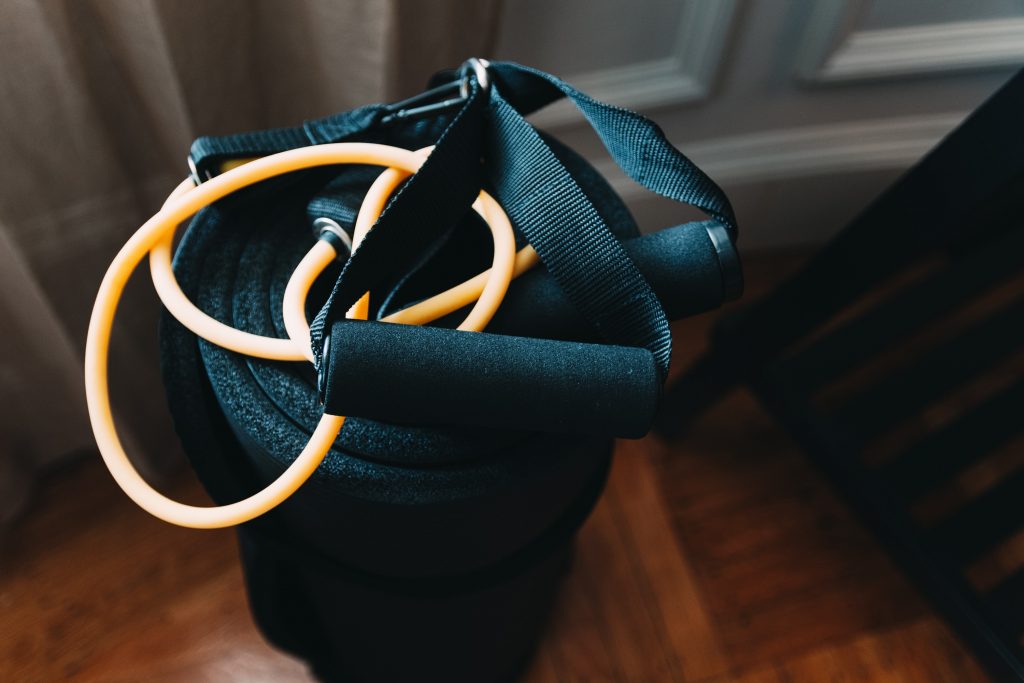
Rubber tubes with handles on each end, usually sold with a door anchor and ankle straps. They feel similar to a cable machine and are great for presses, rows, curls, and lateral raises. Many sets let you clip several tubes together to increase tension.
Mini bands
Short flat loops about 10–12 in (25–30 cm) long, worn around the thighs, knees, or ankles. Ideal for glute and hip work such as lateral walks, clamshells, and bridges, and for warm-ups.
Pull-up assist bands
These are simply heavy large loop bands looped over a bar. You place a foot or knee in the loop and the band helps lift you at the bottom of the pull-up, where it is hardest. Use thinner bands as you get stronger.
Typical resistance ranges
Colors are not standardized between brands, so always check the listed tension. As a rough guide for large loop bands:
| Level | Approx. width | Approx. tension | Common uses |
|---|---|---|---|
| Extra light | 1/4 in (6 mm) | 5–15 lb (2–7 kg) | Mobility, shoulder warm-ups, pull-aparts |
| Light | 1/2 in (13 mm) | 15–35 lb (7–16 kg) | Face pulls, lateral raises, triceps work |
| Medium | 1 1/8 in (29 mm) | 25–65 lb (11–29 kg) | Rows, presses, light pull-up assist |
| Heavy | 1 3/4 in (44 mm) | 35–85 lb (16–39 kg) | Squats, good mornings, pull-up assist |
| Extra heavy | 2 1/2 in (64 mm) | 50–125 lb (23–57 kg) | Deadlifts, heavy assistance, banded barbell work |
Dumbbells and Kettlebells: Fixed vs Adjustable
Fixed dumbbells
Solid, durable, and instant to grab, fixed dumbbells are ideal for supersets and circuits. The downside is space and cost: a full run of pairs from 5 to 50 lb (2–23 kg) in 5 lb steps is ten pairs that need a rack. Buying used at around $0.75–$1.50 per lb can make them much more affordable.
Adjustable dumbbells
Dial or pin-selector models replace up to 15 pairs in the space of one. Most popular models go to 50–52.5 lb (23–24 kg) per hand, with heavier versions reaching 70–90 lb (32–41 kg). Spin-lock handles with plates are the cheapest adjustable option, though slower to change. Avoid dropping any adjustable dumbbell; the selector mechanisms are the weak point.
Kettlebells
The offset handle makes kettlebells perfect for swings, cleans, snatches, goblet squats, and carries. Common starting weights are 18–26 lb (8–12 kg) for many women and 26–35 lb (12–16 kg) for many men, with a heavier bell around 35–53 lb (16–24 kg) for swings once technique is solid.
Combining Both: Accommodating Resistance and a Hybrid Workout
You do not have to choose. Combining bands with weights, often called accommodating resistance, gives you the constant load of a free weight at the bottom plus extra band tension near lockout. Strength coaches have used this approach for decades with barbells, and it works with dumbbells and kettlebells too. Examples:
- Banded goblet squat: Stand on a light loop band and loop the other end around your neck and the dumbbell.
- Banded push-up: Wrap a band across your upper back and hold each end under your hands.
- Banded kettlebell swing: Anchor a light band under your feet and through the handle to add snap at the top.
- Banded hip thrust: Add a mini band above the knees or a loop band over the hips anchored to dumbbells.
Sample hybrid workout
Do this full-body session two or three times per week on non-consecutive days. Use an interval timer to keep rest periods consistent.
| Exercise | Equipment | Sets | Reps | Rest |
|---|---|---|---|---|
| Band pull-apart and mini band lateral walk | Light loop, mini band | 2 | 15 each | 30 sec |
| Banded goblet squat | Dumbbell or kettlebell + light loop | 4 | 6–10 | 2 min |
| Dumbbell Romanian deadlift | Pair of dumbbells | 3 | 8–12 | 90 sec |
| Dumbbell bench press | Dumbbells + bench | 3 | 8–12 | 90 sec |
| Band-assisted pull-up or one-arm dumbbell row | Heavy loop or dumbbell | 3 | 5–10 | 90 sec |
| Banded kettlebell swing | Kettlebell + light loop | 3 | 12–15 | 60 sec |
| Tube band face pull | Tube band + door anchor | 3 | 15–20 | 45 sec |
| Band triceps pressdown + dumbbell curl superset | Tube band, dumbbells | 2 | 12–15 each | 60 sec |
Progress by adding reps within the range first, then increasing the dumbbell weight or moving to a thicker band.
Not sure what to buy first?
Our Equipment Buying Guide & Budget Build gives you a personalized list of bands, weights, and accessories that fits your goals, space, and budget.
Safety Tips for Bands and Weights
Both tools are safe when used properly, but each has its own risks. Bands can snap, and weights can be dropped.
- Check bands for nicks, tears, thinning spots, discoloration, or a sticky or chalky surface before each use.
- Store bands out of direct sunlight and away from heat, and keep them off rough concrete.
- Use only secure anchor points: a rack upright, a heavy post, or a door anchor in a door that closes away from you and is locked.
- Never anchor bands to furniture, radiators, pipes, or anything with sharp edges.
- For dumbbells, check that adjustable selectors are fully locked and spin-lock collars are tight before every set.
- Keep a clear area around you and lift on a rubber mat to protect the floor.
- Avoid dropping adjustable dumbbells or kettlebells on hard floors.
Buying Recommendations by Goal
Use this as a starting point, then adjust for your space and budget.
- Total beginner or tight budget ($50–$100): A set of four or five loop bands, a set of mini bands, and a tube set with a door anchor. Add a single kettlebell when you can.
- Muscle building at home ($300–$600): Adjustable dumbbells to 50 lb (23 kg) per hand, an adjustable bench, and a loop band set for accessories and warm-ups.
- Maximal strength: A barbell, plates, and a rack, with heavy loop bands for accommodating resistance and pull-up assistance.
- Conditioning and fat loss: One or two kettlebells plus a band set. Swings, carries, and band circuits deliver hard work in a small space.
- Travel or small apartments: A tube band set and loop bands. They weigh almost nothing and cover the whole body.
- Rehab-style or joint-friendly training: Light loop bands and mini bands for controlled, low-impact work, ideally alongside a program from a qualified professional.
For more ideas on what to add over time, see our list of 10 essential items to have in a home gym.
Frequently Asked Questions
Can resistance bands build as much muscle as free weights?
For many exercises, yes, as long as you train close to failure and keep increasing the challenge. Bands are less practical for heavy lower-body work and make progress harder to measure, so most people get the best long-term results by combining them with free weights.
How long do resistance bands last?
With regular use, most latex bands last roughly one to three years. Lifespan depends on how often you use them, how far you stretch them, and how they are stored. Replace any band showing nicks, tears, or thinning right away.
Are resistance bands good for beginners?
They are an excellent starting point. Bands are cheap, quiet, and low risk, and they let beginners learn movement patterns and build a base of strength before adding dumbbells. Lighter bands also make warm-ups and assisted pull-ups easier.
Should I buy adjustable dumbbells or a kettlebell first?
Adjustable dumbbells are more versatile and let you progress in small steps, so they suit most people building strength and muscle. A single kettlebell is cheaper and better for swings and conditioning. If budget allows only one, choose based on your main goal.
Do I need a door anchor for tube bands?
A door anchor lets you set the band at chest, overhead, or ankle height, which opens up rows, presses, face pulls, and pressdowns. Use it only on a solid door that closes away from you, and keep the door locked while training.
Maya specializes in mobility, kettlebell training and recovery habits. She helps people who sit all day move better, lift with less pain and build routines that last.