Most beginners do not fail because they pick the wrong exercises. They fail because they have no plan, so every session is a guess. This beginner home workout plan fixes that. Over 12 weeks you will move from bodyweight and bands to dumbbells and then to heavier loads, with clear sets, reps, rest periods, and rules for when to progress. Train three times a week, follow the steps, and you will finish noticeably stronger.
Before You Start: Who It's For and How to Warm Up
Who this plan is for
This program is written for adults who are new to strength training or returning after a long break. It suits you if you:
- Can train at home three days per week for 45–60 minutes.
- Have little or no equipment to start, with the option to add dumbbells by week 5.
- Want general strength, muscle, and better everyday fitness rather than a specific sport.
You do not need a full gym. Weeks 1–4 need only a set of resistance bands and a sturdy chair or bench. Weeks 5–8 need a pair of adjustable dumbbells or a few fixed pairs. Weeks 9–12 work with a barbell and rack, or with heavier dumbbells and harder bodyweight variations. If you are still gathering gear, see our guide to building a home gym on a budget.
The 8-minute warm-up protocol
Do this before every session. It raises your body temperature, rehearses the day's movements, and helps you spot any stiffness before you load it.
- General movement (2–3 minutes): Marching in place, jumping jacks, or easy jump rope until you are slightly warm.
- Mobility (3 minutes): 8 cat-cows, 6 world's greatest stretches per side, 10 leg swings per leg front-to-back, and 10 arm circles each direction.
- Activation (2 minutes): 10 glute bridges, 15 band pull-aparts, and 5 slow bodyweight squats with a 3-second pause at the bottom.
- Ramp-up sets: Before your first loaded exercise in phases 2 and 3, do 2–3 lighter sets at about 50%, 70%, and 85% of your working weight for 3–5 reps.
Progressive Overload and RPE Explained
Your muscles adapt to what you ask of them. To keep improving, you need to gradually ask for a little more. That is progressive overload, and it is the engine of this entire plan.
The double progression rule
Each exercise has a rep range, such as 3 sets of 8–12. Start with a load or variation that lets you complete 8 reps on every set with good form. Each session, try to add a rep or two. When you hit 12 reps on all three sets, increase the load by the smallest step available, usually 2.5–5 lb (1–2.5 kg) for upper-body dumbbell work and 5–10 lb (2.5–5 kg) for lower-body or barbell work, and drop back to 8 reps. With bodyweight or bands, progress to a harder variation or a stronger band.
What RPE means
RPE stands for Rating of Perceived Exertion. In strength training it is commonly scored from 1 to 10 based on how many more reps you could have done.
| RPE | How it feels | Reps left in the tank |
|---|---|---|
| 6 | Moderate, speed stays fast | 4 or more |
| 7 | Challenging but smooth | 3 |
| 8 | Hard, the last rep slows down | 2 |
| 9 | Very hard, one more rep possible | 1 |
| 10 | Maximal effort, no more reps | 0 |
In this plan, most sets should finish around RPE 7–8. That is hard enough to drive progress but leaves a margin for good technique. Avoid going to RPE 10 on squats and hinges as a beginner.
Phase 1 (Weeks 1–4): Bodyweight and Band Foundation
The goal of this phase is to learn the movement patterns, build tendon and joint tolerance, and create the habit. Keep the effort around RPE 6–7 in weeks 1–2, then push to RPE 7–8 in weeks 3–4. Equipment: resistance bands, a sturdy chair or bench, and a backpack or bags you can load for carries.
| Exercise | Sets | Reps | Rest |
|---|---|---|---|
| Box squat to chair or bench | 3 | 10–15 | 60–90 sec |
| Glute bridge (add band above knees in weeks 3–4) | 3 | 12–15 | 60 sec |
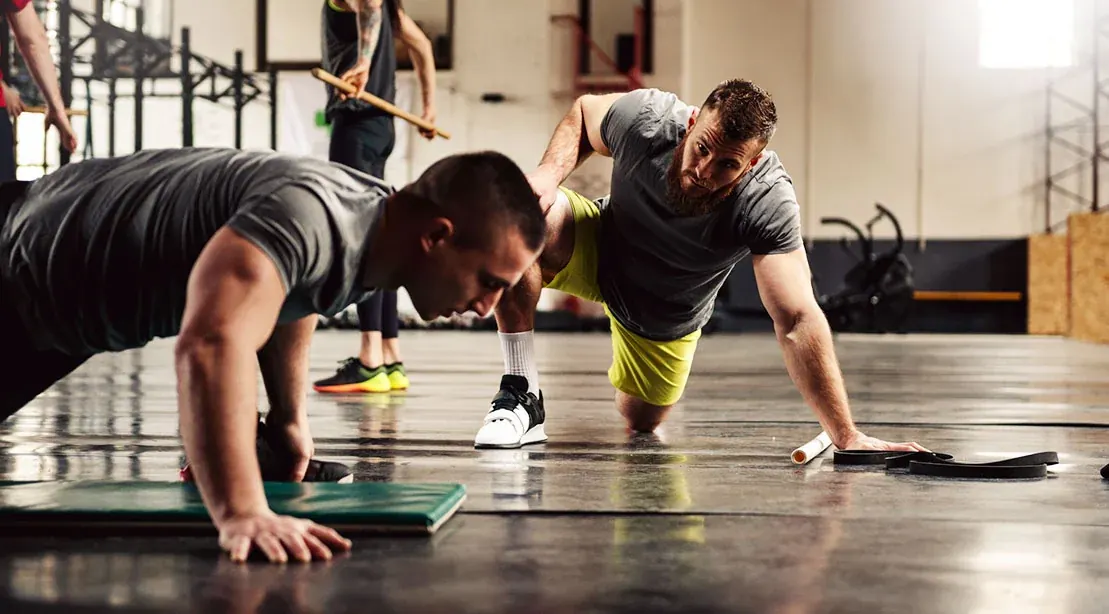
| Incline push-up (hands on bench or counter) | 3 | 8–12 | 60–90 sec |
| Band row, anchored at chest height | 3 | 12–15 | 60 sec |
| Reverse lunge, holding support if needed | 2 | 8 per leg | 60 sec |
| Band pull-apart | 2 | 15–20 | 45 sec |
| Dead bug | 3 | 6–8 per side | 45 sec |
| Backpack farmer carry | 3 | 30–40 m (about 100–130 ft) | 60 sec |
Progressions in this phase: lower the incline for push-ups, use a thicker band for rows, and slow the lowering phase of squats to 3 seconds.
Phase 2 (Weeks 5–8): Building With Dumbbells
Now you add external load. A pair of adjustable dumbbells reaching at least 35–50 lb (16–23 kg) per hand is ideal. Choose starting weights that put the first set at about RPE 7. Typical beginner starting points are 15–30 lb (7–14 kg) for a goblet squat and 10–20 lb (4.5–9 kg) per hand for presses and rows.
| Exercise | Sets | Reps | Rest |
|---|---|---|---|
| Goblet squat | 3 | 8–12 | 90 sec |
| Dumbbell Romanian deadlift | 3 | 8–12 | 90 sec |
| Dumbbell bench or floor press | 3 | 8–12 | 90 sec |
| One-arm dumbbell row | 3 | 10–12 per side | 60–90 sec |
| Rear-foot-elevated split squat | 2 | 8–10 per leg | 60–90 sec |
| Seated dumbbell overhead press | 2 | 8–10 | 60–90 sec |
| Dumbbell farmer carry | 3 | 40 m (about 130 ft) | 60 sec |
| Front plank | 3 | 30–45 sec | 45 sec |
Keep using bands for pull-aparts as part of your warm-up. If you have a pull-up bar, swap the overhead press for band-assisted pull-ups on one of the three days.
Phase 3 (Weeks 9–12): Barbell or Heavier Progressions
By now your technique is solid and your body is ready for heavier work with lower reps. If you have a barbell and rack, use the main column. If not, use the dumbbell or bodyweight alternative and keep pushing the rep ranges.
| Exercise (alternative) | Sets | Reps | Rest |
|---|---|---|---|
| Barbell back squat (heavy goblet or tempo split squat) | 4 | 5–8 | 2–3 min |
| Barbell Romanian deadlift (single-leg dumbbell RDL) | 3 | 6–8 | 2 min |
| Barbell bench press (dumbbell bench or deficit push-up) | 4 | 6–10 | 2 min |
| Chin-up or band-assisted pull-up (heavy one-arm row) | 3 | 3–8 | 2 min |
| Standing barbell overhead press (standing dumbbell press) | 3 | 6–8 | 90–120 sec |
| Walking lunge with dumbbells | 2 | 10 per leg | 90 sec |
| Heavy farmer or suitcase carry | 3 | 30–40 m (about 100–130 ft) | 90 sec |
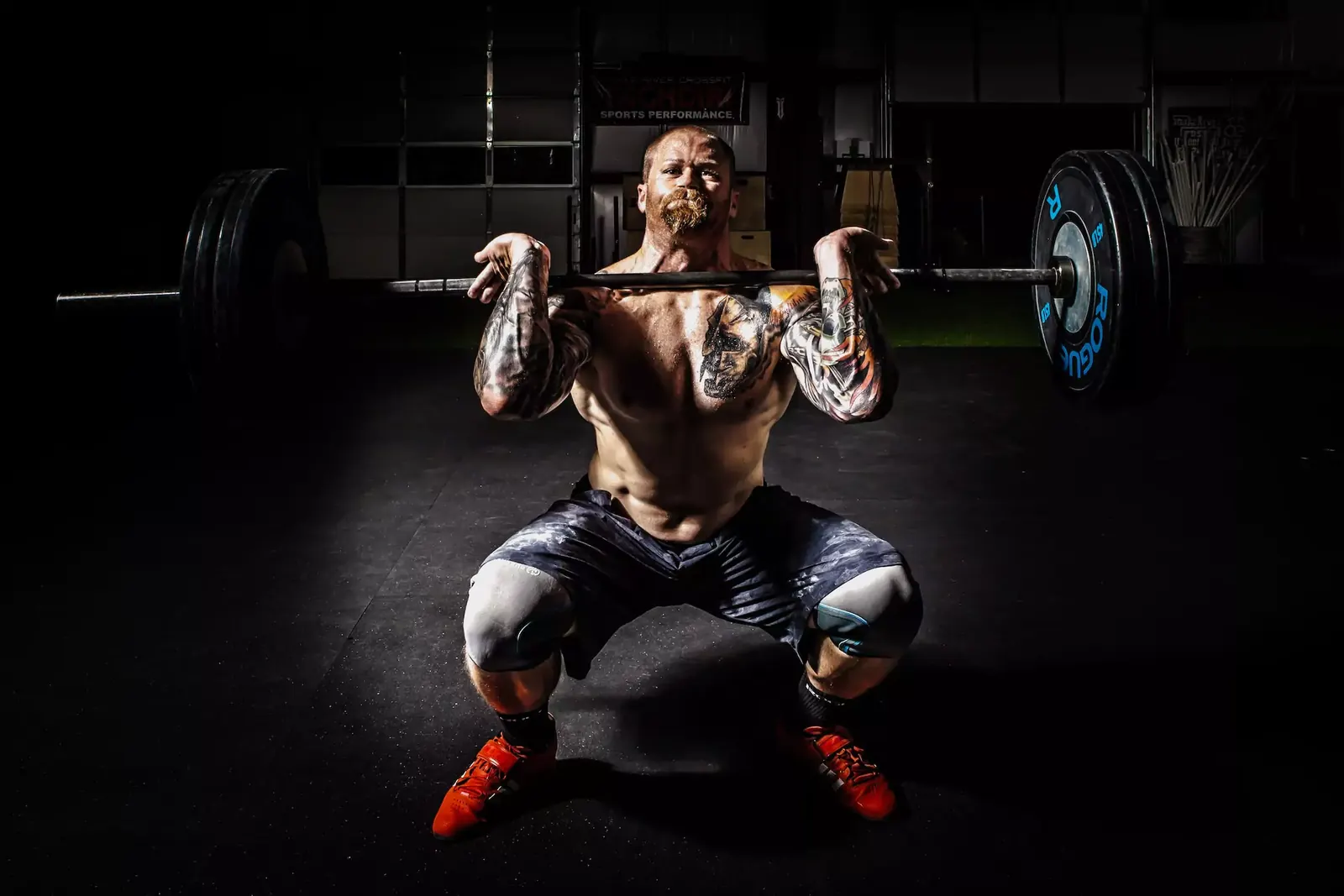
Start the barbell squat with an empty 45 lb (20 kg) bar, add 5–10 lb (2.5–5 kg) per session while sets stay at RPE 8 or below, and set the rack safeties just below the bottom of your squat. Use our one-rep max calculator to estimate your strength from a set of 5–8 reps instead of testing a true maximum.
Want a 12-week plan built around you?
Get a custom program matched to your equipment, schedule, and goals, with progressions planned for every week.
Technique Cues for the Five Key Patterns
Good technique keeps you safe and lets you lift more over time. Film a set from the side every few weeks and compare it with these cues.
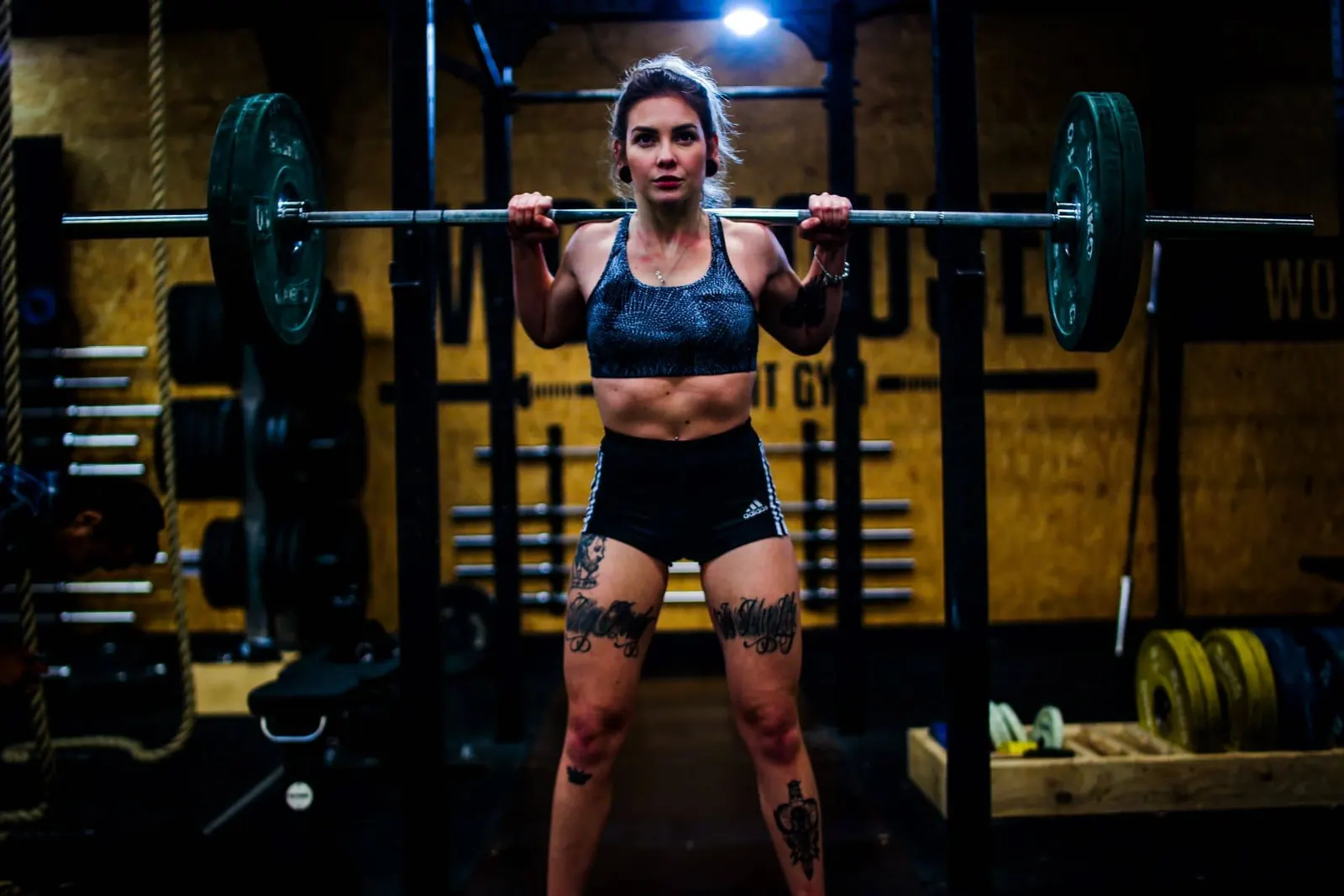
Squat
- Feet about shoulder-width, toes turned out 15–30 degrees.
- Brace your midsection as if about to be poked in the stomach, then sit down between your heels.
- Knees track in line with your toes; it is fine for them to travel forward past the toes.
- Go as deep as you can while keeping your heels down and lower back neutral.
Hinge
- Soft knees, then push your hips straight back as if closing a car door with your backside.
- Keep the weight close to your legs and your spine long from head to tailbone.
- Stop when you feel a strong hamstring stretch, usually around mid-shin, then drive your hips forward to stand.
Push
- For push-ups and presses, keep your body or torso rigid and your elbows about 30–45 degrees from your sides.
- Lower under control for about 2 seconds and press back up without losing your brace.
- Overhead: squeeze your glutes, keep ribs down, and finish with the weight over your mid-foot.
Pull
- Start each rep by drawing your shoulder blade back and down, then pull your elbow toward your hip.
- Pause for a second at the top of rows and avoid twisting your torso to cheat the weight up.
Carry
- Stand tall, shoulders down and back, and grip the handles hard.
- Take short, controlled steps without leaning. A suitcase carry with one weight trains your core to resist side bending.
Weekly Schedule, Tracking, and Deloads
Sample weekly schedule
| Day | Session |
|---|---|
| Monday | Full-body workout |
| Tuesday | 20–40 min walk or easy cardio |
| Wednesday | Full-body workout |
| Thursday | Mobility session or rest |
| Friday | Full-body workout |
| Saturday | Optional intervals, hike, or sport |
| Sunday | Rest |
Any three non-consecutive days work. Combined with daily walking and optional cardio, this schedule moves you toward the widely recommended 150–300 minutes of moderate activity per week. Our interval timer makes it easy to keep rest periods honest during workouts and to run conditioning circuits on Saturdays.
Tracking progress
Log the date, exercise, weight, sets, reps, and RPE for every session in a notebook or app. Every four weeks, also record:
- Your best set of 5–8 reps on squat, hinge, and press.
- Maximum push-ups or chin-ups in one set with good form.
- Bodyweight and waist measurement, taken at the same time of day.
- Sleep quality, energy, and any joint aches.
- One side-on video of your main squat and hinge.
Recovery depends heavily on sleep and food. Aim for 7–9 hours of sleep and, for strength training, a protein intake of about 1.6–2.2 g per kg of bodyweight per day. Our guide to nutrition for home workouts covers this in detail.
When to deload
A deload is a planned easy week. Take one after week 8, or earlier if you stall on most lifts for two weeks in a row, feel run down, or notice nagging aches. During a deload, keep the same exercises, cut the number of sets in half, and reduce the weight by about 10–20% so every set feels like RPE 5–6.
Modifications for Limited Equipment
No barbell, no problem. You can make bodyweight and light-load exercises far harder without adding much weight:
- Slow the tempo: Take 3–4 seconds to lower each rep.
- Add pauses: Hold 2 seconds at the bottom of squats, lunges, and push-ups.
- Go single-limb: Swap squats for split squats or step-ups, and hip hinges for single-leg Romanian deadlifts.
- Use 1.5 reps: Go all the way down, halfway up, back down, then all the way up for one rep.
- Increase range of motion: Deficit push-ups on books or rear-foot-elevated split squats.
- Combine bands with weights: Loop a band around your back for push-ups or under your feet during goblet squats.
If you are deciding which gear to buy next, our comparison of resistance bands vs free weights explains the trade-offs.
Frequently Asked Questions
How long should each workout take?
Plan on 45–60 minutes including the 8-minute warm-up. Phase 1 sessions are often closer to 40 minutes, while phase 3 sessions run longer because of the 2–3 minute rest periods on heavy lifts.
Can I train four or five days a week instead?
Three full-body sessions are enough for beginners to make excellent progress. On other days, walking, light cardio, or mobility work will support recovery better than extra lifting sessions. If you want more structure, add one short conditioning session.
What if I cannot do a single push-up or pull-up yet?
Start push-ups with your hands on a wall or kitchen counter and lower the incline each week. For pull-ups, use a heavy pull-up assist band, or do slow 3–5 second lowering reps from the top position, and build up from there.
Will this plan help me lose fat?
Strength training helps you keep and build muscle while losing fat, but fat loss itself depends mainly on a modest, sustained calorie deficit. Pair this plan with daily walking and sensible eating for the best results.
What should I do after the 12 weeks?
Take a deload week, retest your key lifts, then run phase 3 again with new rep targets or move to an upper/lower split four days per week. Keep applying double progression and logging your sessions.
Alex designs AWSA's strength programs and equipment guides. He has spent more than a decade coaching beginners and busy professionals to train safely with whatever equipment fits their home.